An established farm is an asset. You get a new seller every month from your mailers, you have a dozen interested buyers in your Instagram DMs, and you have your Open House signs up every weekend.
But it's also a maintenance job. To remain the local real estate expert, you need to know more about every listing than your neighbors. You need fresh content on your social media every week. You need to understand how that record setting sale affects your seller's expectations.
Top real estate agents are using AI to reduce the amount of work required to remain the neighborhood export. Let us show you how.
Start by defining the farm the way you understand it
Every neighborhood has different segments. The snowbirds want the single level homes with a south facing backyard for more sun in the winter. The young families want a pool and an extra bedroom. Renovated properties may set expectations that original-condition homes cannot match.
AI products like RealTalk can analyze the neighborhood in the same terms you do.
Start by telling RealTalk the farm and your segments in plain language:
RealTalk will search the actual MLS, monitor changes, and help you interpret them. It can also analyze inventory, pricing trends, and buyer or seller indicators inside that scope.
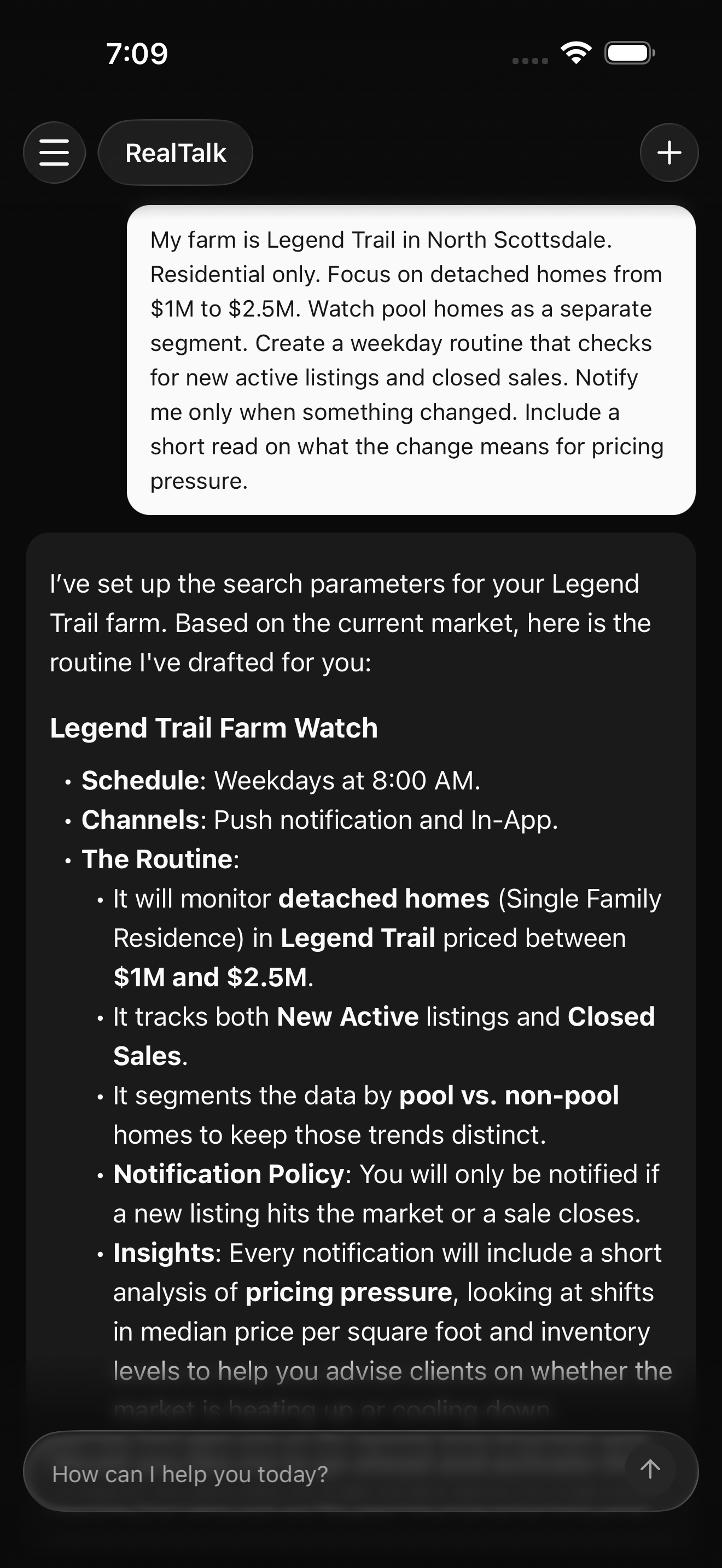
The more specific you are, the more useful the output becomes. As the notifications come in, let RealTalk know what is useful and what is not, and the workflow will get better at telling you what you need to know.
Use case 1: Offer insights your neighbors aren't get from Zillow
Your neighbors are already getting alerts from Zillow. New listings, price changes, and the all-knowing "Zestimate". They're scrolling listings and already know the basics.
RealTalk can surface insights and analysis that your audience isn't getting on Zillow.
Take a new listing at $2.4M, the top of your Legend Trail pool-home band. The Zillow alert says "new listing." RealTalk can tell you something more like:
- New listing at the top of the Legend Trail pool-home band.
- Median days on market in this band has moved from 38 days 90 days ago to 62 days today.
- The last two homes listed above $2M cut price within three weeks.
- This is a stretch price. The seller is likely to come down.
When your seller clients ask you about the listing, now you're ready to go with a comforting answer based on real MLS data.
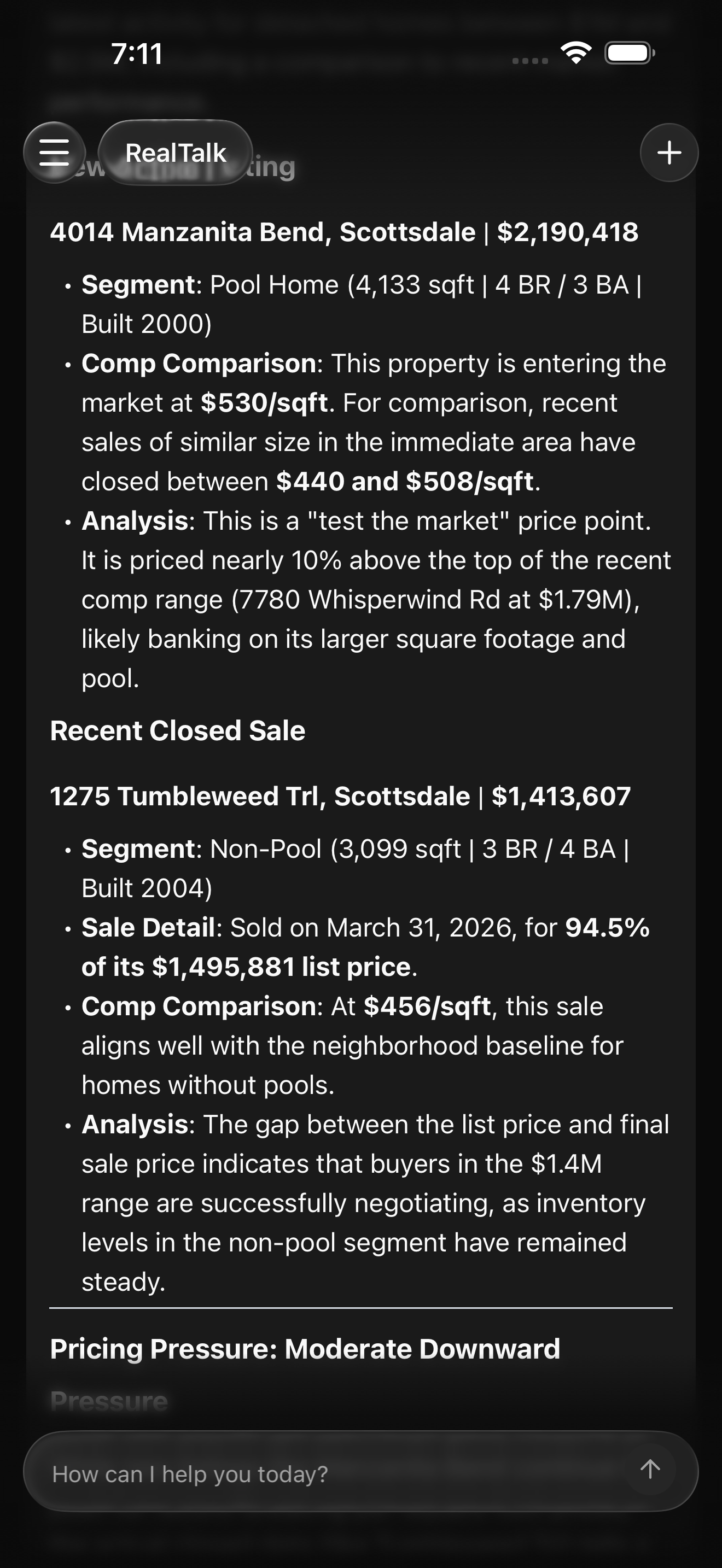
The same logic applies in the other direction. A flip closes above ask after five days, and RealTalk notes that the sale is 9% above the comparable non-renovated set, so the data point only applies to renovated stock. Three listings in the same school catchment sit past 45 days, and the alert flags that absorption is slipping for that segment. A pocket listing closes off-market, and the read surfaces it from the closed records with the price relative to your last active listing nearby.
Each one is a decision input, not just news. You know whether to call a seller, update a buyer, hold the price, or ignore it.
If the read prompts a question, ask the follow-up:
RealTalk will pull comparable properties for a specific address, including sold and active competition. That gives you the backup before you make the call.
Use case 2: Draft segment-specific market updates inside the same farm
One farm does not mean one audience. A buyer looking for a pool home needs a different update than an owner of an original ranch.
Tell RealTalk the segments you want analyzed.
RealTalk will search the MLS inside your farm boundaries wit the filters you want. Then it will synthezie the results into a client-ready draft.
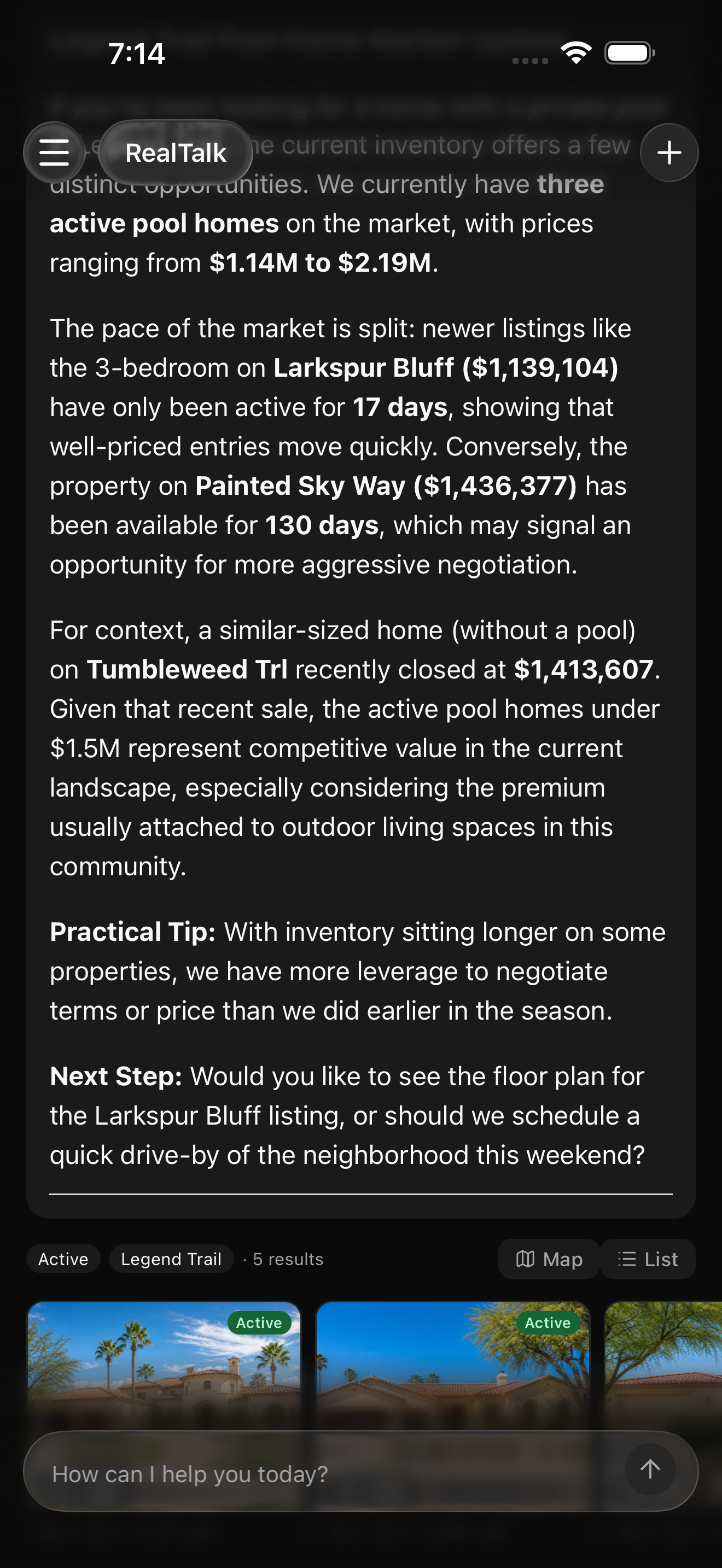
For this kind of update, look for:
- Active inventory for the exact segment
- Days-on-market pressure
- Recent closed-sale context
You can send concierge level advice to each of your clients, without doing a prohibitive amount of analysis.
Repeat the same workflow for different pockets:
- Legend Trail owners with homes over 3,500 square feet.
- Sellers in Legend Trail competing with new renovated inventory.
- Buyers watching single-story homes near the golf course.
RealTalk can also read your CRM. That means you can ask for people who match your segment, such as buyers tagged Legend Trail Pool or sellers in a Legend Trail smart list.
Use case 3: Create local social content from signals
Neighborhood content works when it sounds like a neighbor who knows the area. It falls flat when it sounds like a canned market report.
RealTalk can start from something real in the farm:
- A recent sale that reset expectations
- A sudden shortage of pool homes
- A seasonal pattern that shows up in the local data
Then it can offer some ideas for social media content across all your channels.
Try a prompt like this:
RealTalk is not a social scheduler. It will not post for you. The value is that the post starts with actual MLS activity, market analysis, or neighborhood context instead of a vague line about the market being hot.
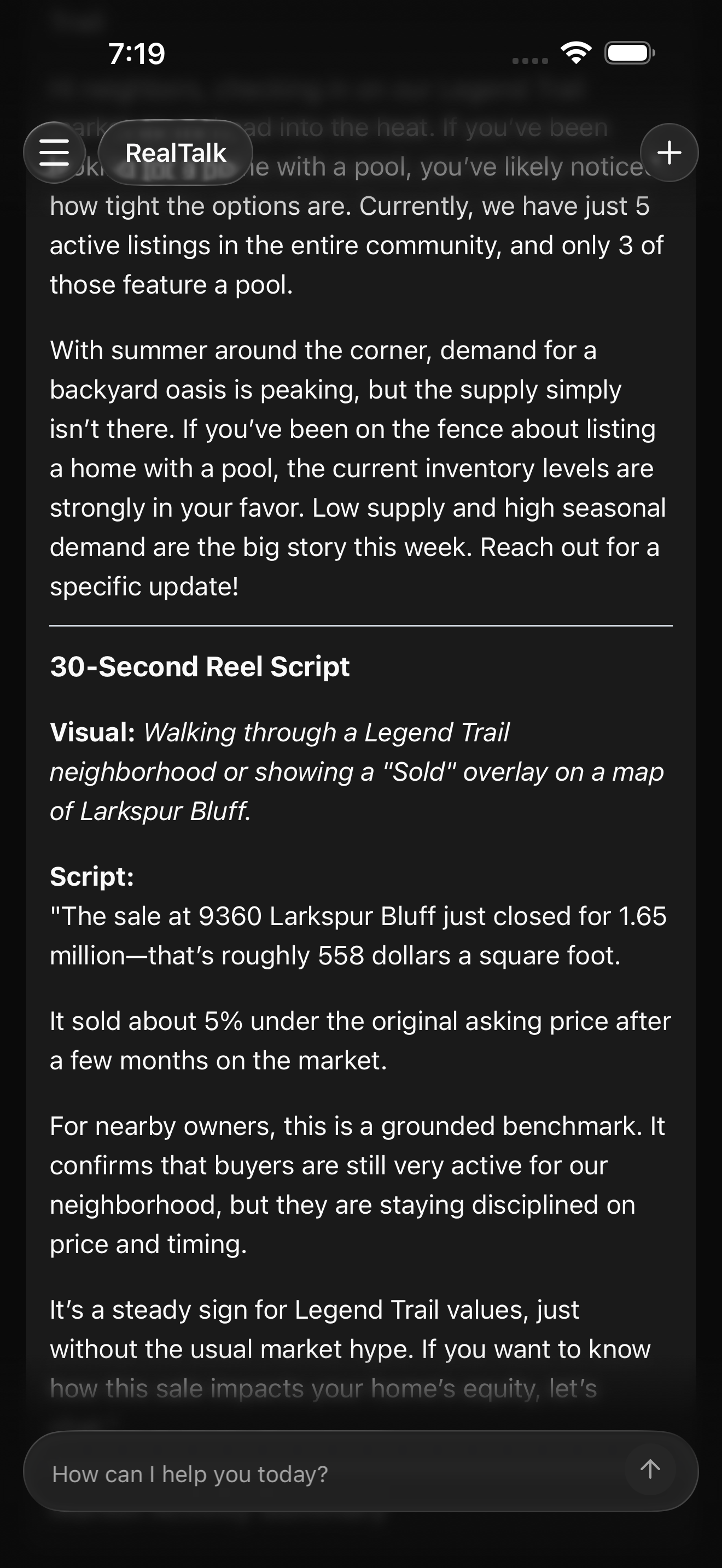
If the content mentions a sale, ask RealTalk to show the comp set behind it. If it references the area around a listing, RealTalk can surface nearby amenities and lifestyle highlights. You still decide what belongs in a public post vs. direct communication with your clients.
Neighobrs can tell when you are paying attention. AI makes it easier to pay attention.
A simple weekly rhythm
Once the pieces are in place, the operating rhythm is straightforward.
Let the farm alert run on a daily schedule. When something meaningful happens, ask RealTalk for the analysis that your audience and clients will find actionable.
Once a week, draft a focused update for one audience in the farm. Keep it specific enough that the right viewer thinks, "Wow. This was written exactly for me."
When there is a clean local signal, turn it into a short neighborhood post or a quick video script. Review it, make it sound like you, then post it where your neighbors are scrolling.
What RealTalk is not doing
RealTalk does not create trust by itself. Your years in the neighborhood are the most important thing. Your sponsorships, events, and past clients all matter.
You can teach your own personal RealTalk all of the things you've learned through the years, such as the odd lot or the busy street. RealTalk will amplify your authority as a neighborhood expert.
Start today
Farming rewards consistency. RealTalk takes on the repetitive work of watching activity and translating it into useful language. You still show up as the local expert. You just spend less of your week doing analyst work, and more of your time serving your clients.