
The listings in this post are not real properties to illustrate the workflow you would use with your own MLS data.
Getting your investor client under contract
Do you have one of those investor clients that keeps stringing you along, telling you they'll buy a home but everything you show them just isn't quite right?
After sending them a dozen listings over 6 months, you probably stopped spending your time scouring the MLS looking for a deal. They are just not a serious buyer.
Or are they?
Maybe the problem is that they are already seeing the listings. Other agents, Zillow, wherever. Nothing made your email stand out. Nothing got them excited about the opportunity.
This post will show you how you can use AI to go the extra mile and get your investor client under contract.
The best part? With AI you can scan all the listings in the MLS for good investment opportunities in less than a minute.
1. Screen the zip code
Start with the area your investor likes to work in. A city, zip code, or even subdivision. And the price range they are comfortable with.
RealTalk screens every single active listings that fit and ranks them by potential after-repair upside. It pulls comps with upgraded finishes near the listing. For every single listing. In just a few seconds.
RealTalk goes even further. It looks at the listing photos for the actives and the comps, to make sure these are good candidates for rehab and that the comps are good for judging post-rehab value.
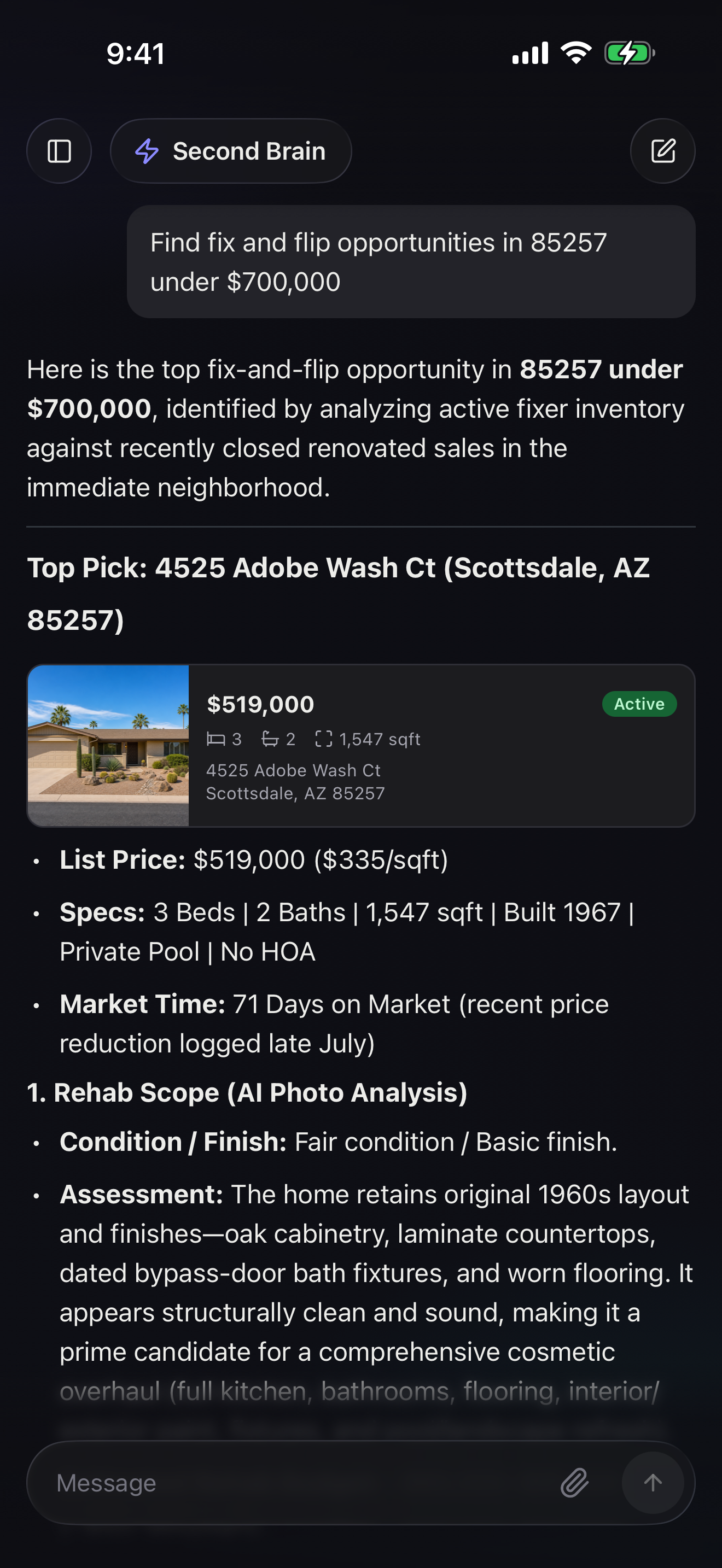
Our search returned a short set of options. At the top is 4525 Adobe Wash Ct, a 1,547-square-foot ranch listed at $519,000. It has a pool and no HOA. The photos suggest basic finishes and fair condition. It has also been on the market for 71 days after a July price cut.
2. Prove the after-repair value
Looks promising. Let's dig in:
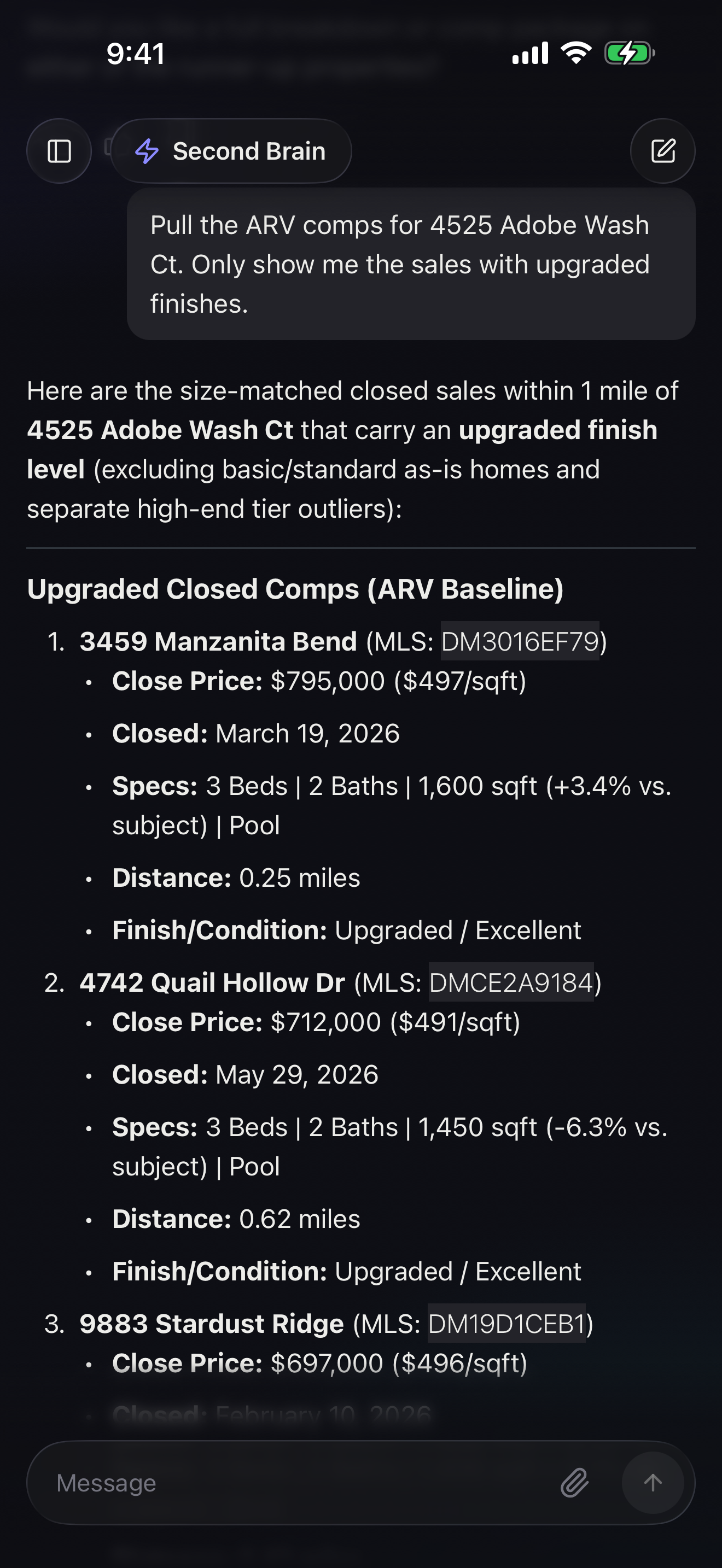
RealTalk finds six closed sales within a mile and within 15% of the subject's square footage. Based on the photos, RealTalk judges them to have upgraded finishes and be in excellent condition.
3. Look at what the money bought
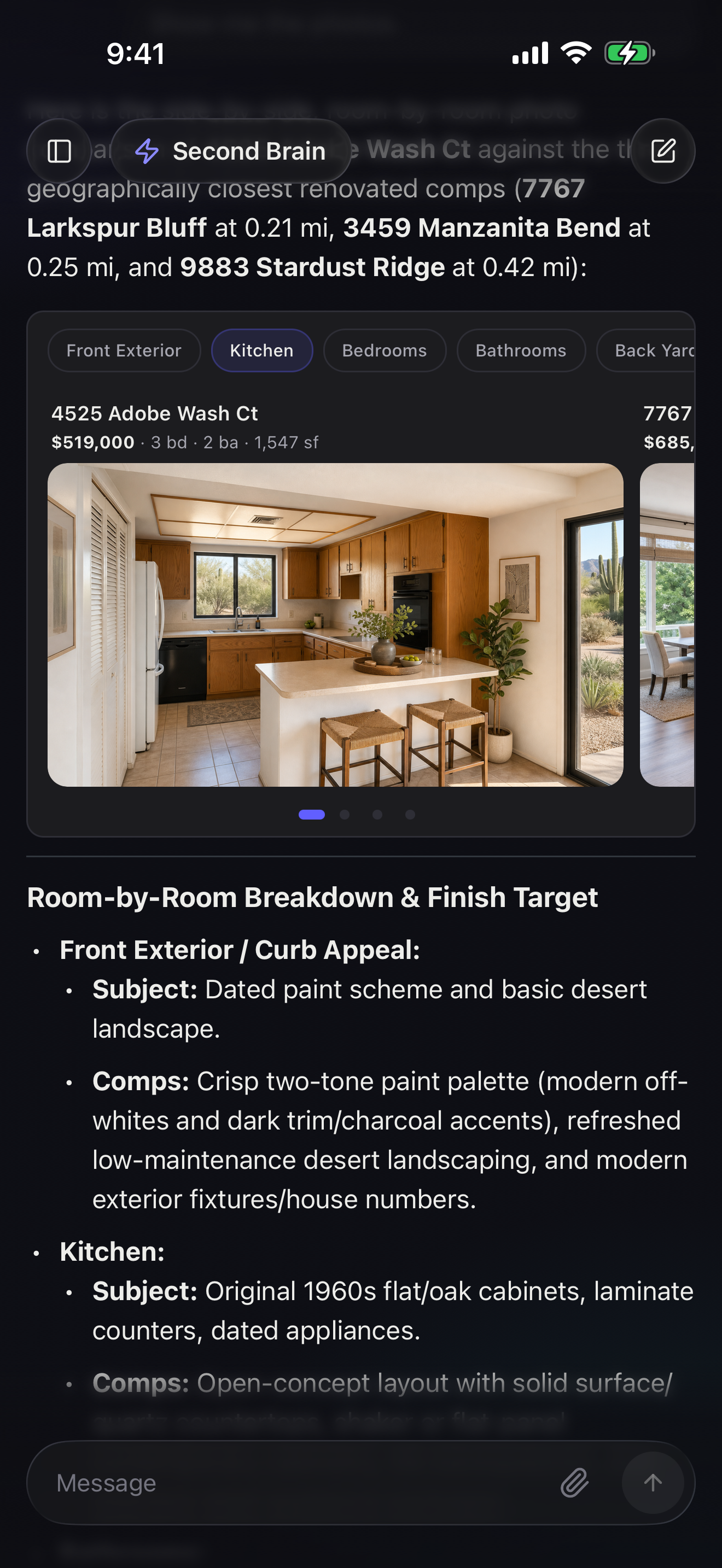
RealTalk lines up the rooms and explains the visible differences. In the subject kitchen, the cabinets and counters are dated. The renovated comps show open layouts with newer cabinetry and solid-surface counters. Outside, the subject's paint and landscaping also trail the finished homes.
This is where your judgment and experience is important. How much would your investor have to spend to rehab the property to get it to the ARV comp level?
4. Exploring an offer
Investors first screen is the 30% check. Is there enough margin available to make this worth the time and risk?
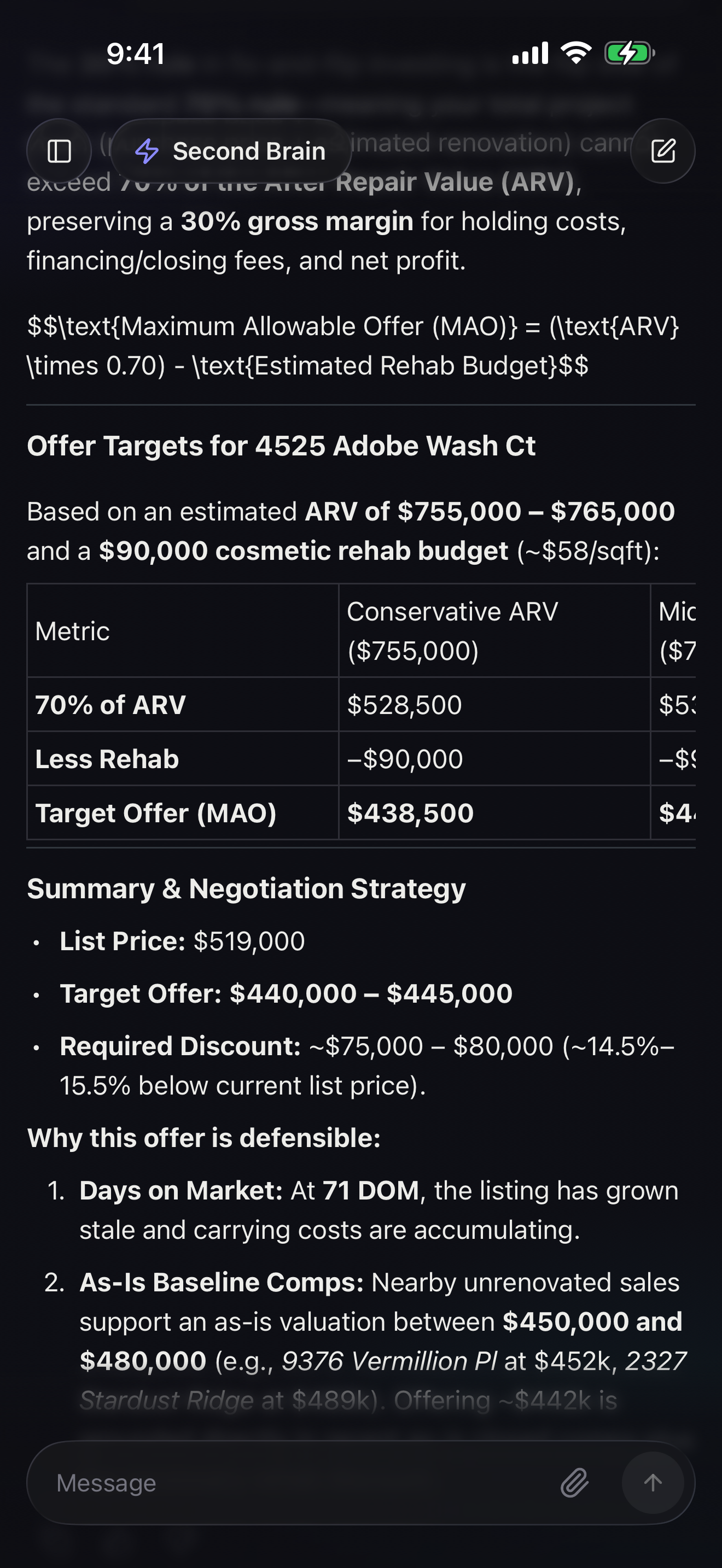
With a $755,000 ARV and a $90,000 renovation budget, the ceiling comes to $438,500. Using the high end of the ARV range gets you to roughly $445,000. To have the 30% margin, your offer will have to be about 15% below the $519,000 asking price.
5. Is it worth writing the offer?
Before presenting this to your client, one last thing. Ask RealTalk if it's likely you can get the property under that maximum allowable offer price we just came up with.
RealTalk returns a more useful answer than a simple yes or no.
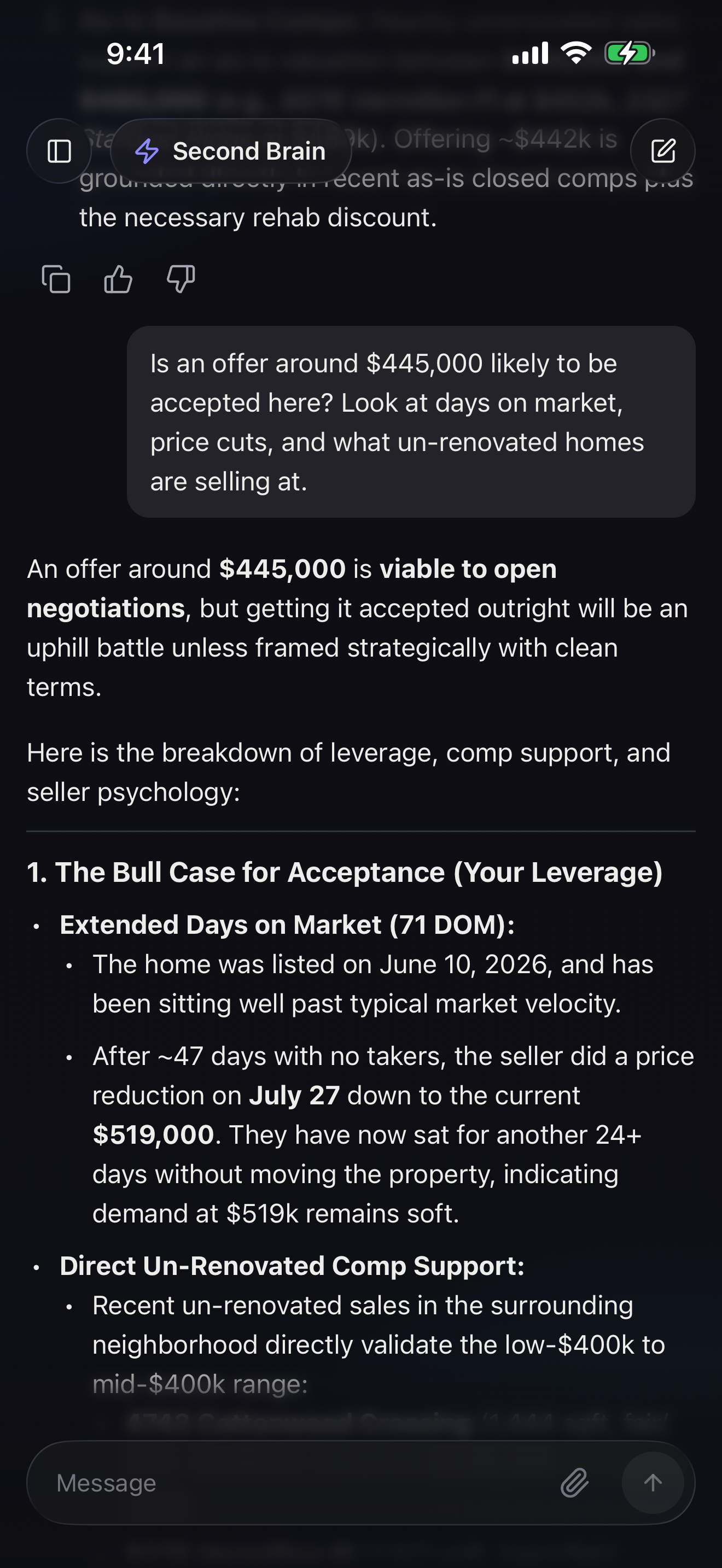
RealTalk thinks that an offer at $445,000 is supported by the as-is sales, which range from $421,000 to $489,000. The listing has also been active for 71 days and has already had one price cut. It has now spent another three weeks at $519,000 without selling.
What you send to your investor client
Instead of just sending a listing with "What do you think?", now you're set to put together a full presentation for why your investor should make an offer. You know what you're talking about now, and your client doesn't have to do any of the work.
You send them and walk them through:
- A short list of possible candidates ranked by upside
- An after-repair value supported by upgraded closed sales
- A visual comparison of the work needed to match with those sales
- An offer ceiling
- A realistic expectation for how the seller may respond to that offer
All of this in just a few minutes with RealTalk.